Independent visitor guide
Singapore's hawker centres: a UNESCO listing, 114 buildings and the cheapest good food anywhere
Inscribed by UNESCO in 2020 as "community dining rooms", the hawker centres are the best thing to eat in Singapore and among the cheapest. There is no ticket. There is a system, and it takes about a day to learn.
- Last checked: 29 August 2026
- 4 ticket options tracked
- Not the official site This is not the official website Singapore Tickets Guide is an independent travel guide. We do not own, run or represent any attraction on this site and we do not issue tickets ourselves. Booking links go to Headout, an authorised reseller, and we may earn a commission. For official information, always use the operator’s own website. About this site →
Live inventory
Tickets and passes available right now
Live options from our booking partner. Prices update automatically.
 Most booked
 Guided Michelin and Local Hawker Food Tour
$85.74From · per person

Guided Bicycle Food Tour in Singapore
$70.79From · per person

Small Group Guided Night Food Tour in Singapore
$85.74From · per person

Market to Table Culinary Tour Experience
$101From · per person
Prices shown are the current lowest listed by our booking partner and can change.Last checked: .
| Cost | Free to enter, a few dollars to eatThere is no admission. A plate of chicken rice or a bowl of laksa runs a fraction of restaurant prices. |
|---|---|
| UNESCO status | Inscribed 16 December 2020UNESCO described the hawker centre as "community dining rooms" where people from diverse backgrounds share the experience of dining. |
| How many | More than 114At least 114 hawker centres existed as of 2018, spread across the island rather than concentrated downtown. |
| Why they exist | Built from the 1950s and 1960sConstructed during rapid urbanisation, partly to address unhygienic food preparation by unlicensed street hawkers. |
| Michelin recognition | 40-plus stallsAs of 2019 more than 40 hawker stalls held a Michelin Star or Bib Gourmand. By 2023 they made up the majority of the list. |
| Best times | 11:00–13:00 and 18:00–20:00The famous stalls sell out. Popular items are gone by early afternoon at many centres. |
| Payment | Cash and increasingly QRMany older stalls are still cash-preferred. Carry small notes. |
Opening hours and on-the-gate prices come from the operator’s official website. Always re-check before you travel. Official site: National Environment Agency
Ticket comparison
Which ticket should you buy?
Guided Michelin and local hawker food tour
$85.74 From · per person
Compressing three days of trial and error into one morning.
- Chinatown Complex, Maxwell and Hong Lim food centres
- Nine to ten tastings over 3.5 hours
- A guide who knows which queue means something
Daily from Chinatown MRT. Read the Monster Day Tours review before booking.
Check pricesSmall-group guided night food tour
$85.74 From · per person
An evening rather than a morning, and the after-dark centres.
- A guided evening route through hawker food
- Small-group format
- The stalls that only open at night
Singapore's hawker scene has a distinct night shift, and most tours only show you the day one.
Check pricesLowest price
Guided bicycle food tour
$70.79 From · per person
Eating across neighbourhoods rather than within one.
- Cycling between food stops
- More ground covered than a walking tour
- A flat, compact city that suits it
Solves the structural problem with walking food tours, which is that you eat nine dishes while covering four hundred metres.
Check pricesThere is no ticket on this page because there is nothing to buy.
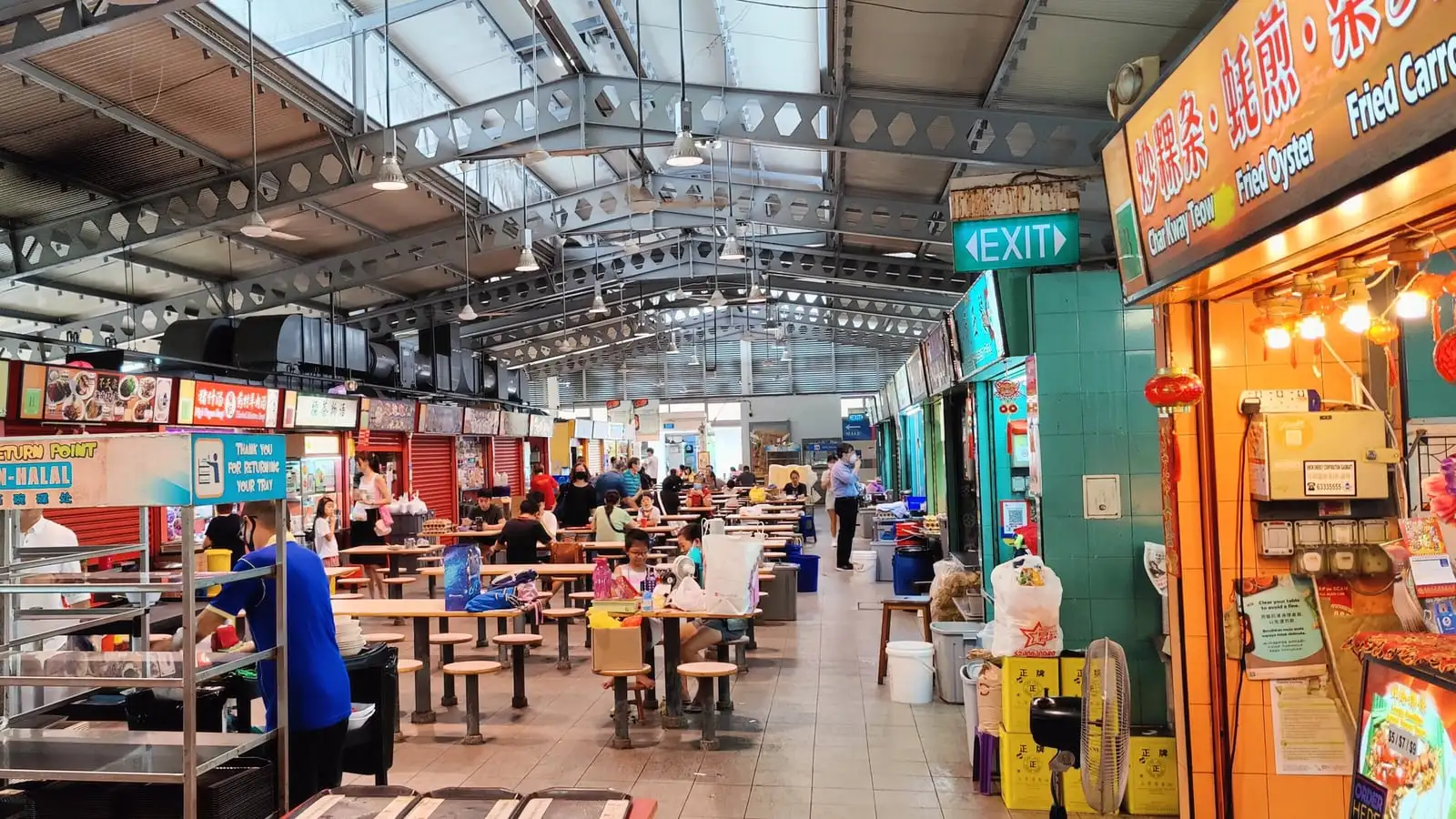
Singapore has more than 114 hawker centres, built from the 1950s and 1960s during rapid urbanisation, partly to bring unlicensed street hawkers into buildings with plumbing. On 16 December 2020 UNESCO inscribed hawker culture on its list, describing the centres as "community dining rooms" where people from diverse backgrounds gather and share the experience of dining over breakfast, lunch and dinner.
The food costs a few dollars a plate. It is the best thing in this country and the cheapest, and this page is about how to use it.
The system, in four rules
Singapore's hawker centres run on conventions that nobody explains to you and everybody follows.
1. Find a seat first, then order. At peak hours the seat is the scarce resource, not the food.
2. The tissue packet means the table is taken. Placing a packet of tissues on a table reserves it — the local term is chope. An empty table with a tissue packet on it is not empty. This is enforced socially and absolutely.
3. Order from multiple stalls. Each stall does one thing. A table of four should be eating from four stalls, not one. Payment is per stall, usually at the counter.
4. Return your tray. Since 2021 clearing your table has been mandatory, and there are tray return points at every centre. Do it.
Add one more that is not a rule but is close to one: join the long queue. Singaporeans queue with a precision that borders on data collection. A forty-minute queue at one stall and an empty counter beside it is telling you something real.
Which centres, and what each is for
| Centre | Where | Go for |
|---|---|---|
| Maxwell Food Centre | Chinatown | The famous central one. Chicken rice, congee, and a five-minute walk from the MRT |
| Chinatown Complex | Chinatown | The largest, with hundreds of stalls. Overwhelming and the best value in the country |
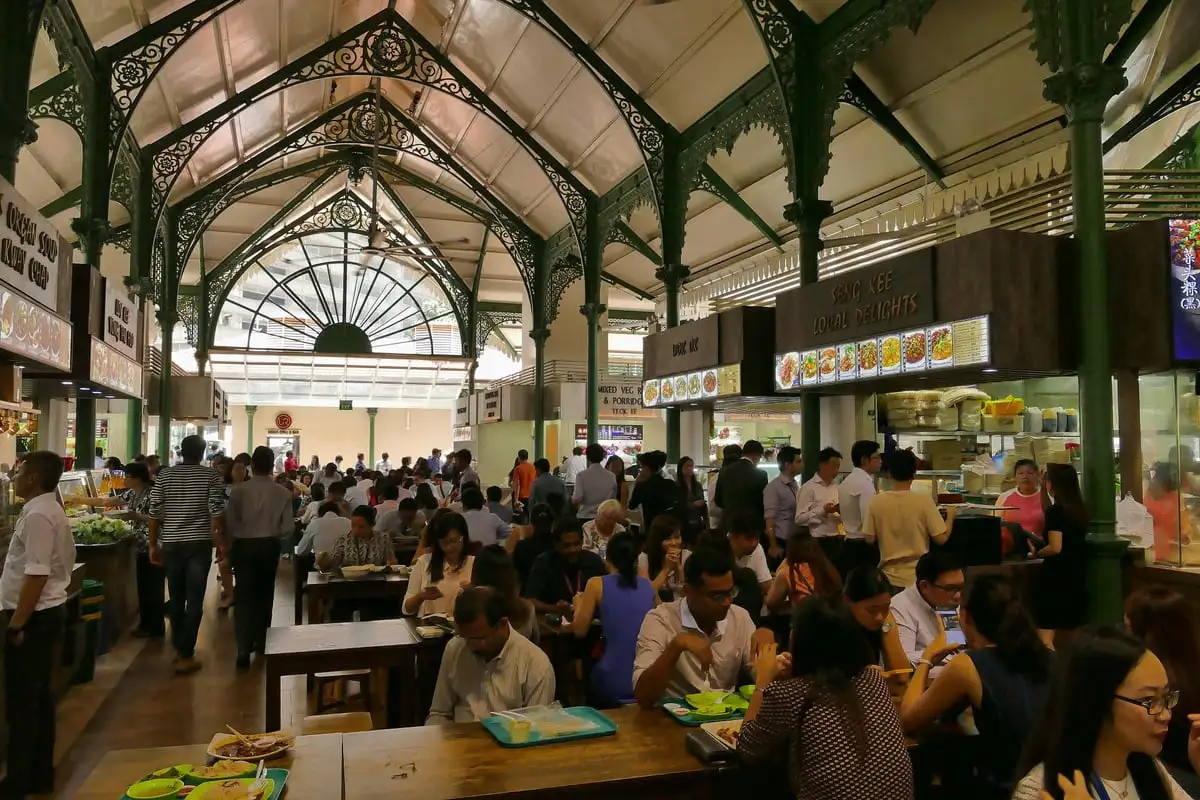
| Lau Pa Sat | CBD | A Victorian cast-iron market hall, and the satay street that opens on Boon Tat Street after dark |
| Old Airport Road | Geylang / east | The one serious eaters name first. Worth the trip east |
| Tekka Centre | Little India | South Indian food, and the best wet market in central Singapore downstairs |
| Tiong Bahru Market | Tiong Bahru | Smaller, calmer, in the art deco estate. Good for a first visit |
| Amoy Street Food Centre | CBD | Lunchtime only in practice — office crowd, excellent, dead in the evening |
If you only visit one, make it Chinatown Complex or Maxwell for convenience, or Old Airport Road if you are prepared to travel for it.
If you visit three, make them different types: a central one, an estate one, and a night one.
What to order
Start here and branch out. All of these are available at most centres and all cost a few dollars.
- Hainanese chicken rice — poached chicken, rice cooked in the stock, chilli and ginger on the side
- Char kway teow — flat rice noodles fried hard with cockles, egg and sweet soy
- Laksa — coconut and dried shrimp broth, thick noodles, a Peranakan dish and the one visitors most often want to learn to cook
- Bak chor mee — minced pork noodles with vinegar, the most divisive and most rewarding entry on this list
- Roti prata — flatbread with curry, at the Indian-Muslim stalls, best in the morning
- Carrot cake — no carrot, no cake; radish and egg fried in a wok, black or white
- Hokkien mee, satay, rojak, chwee kueh, kaya toast with soft-boiled eggs
On Michelin: more than 40 hawker stalls held a Star or Bib Gourmand as of 2019, and by 2023 they made up the majority of the Singapore list. They are good. They also have the longest queues in the country, and the stall next door is frequently almost as good with nobody waiting.
Timing
11:00 to 13:00 and 18:00 to 20:00 are when everything is open and everything is busy.
The famous stalls sell out. At many centres the notable items are gone by early afternoon, and some stalls simply close when they run out. Do not plan a 15:00 visit to a specific stall.
Breakfast is underrated. Kaya toast, soft-boiled eggs and kopi from about 07:00 is a cheap, excellent and almost empty way to start a day.
Amoy Street is a lunch centre, effectively dead in the evening, because it serves the office district.
Lau Pa Sat's Satay Street on Boon Tat Street opens after dark and is the best evening hawker atmosphere in the city centre.
Stall closures are common on Mondays and Tuesdays, and stalls take individual holidays. If a specific stall is the reason you are going, check before you travel.
When to pay for a tour
The food costs a few dollars. A guided hawker tour costs upwards of S$100. That gap is entirely selection and explanation, so be clear about what you are buying.
A tour is worth it if you have one food day, if hawker centres are unfamiliar, or if you are travelling with people who will not order confidently. It compresses about three days of trial and error into three and a half hours.
A tour is not worth it if you have five days and any curiosity at all. Walk into Maxwell, join the longest queue, and repeat.
We have reviewed the operators in detail: Monster Day Tours runs the daily Chinatown route, Hello! Singapore Tours covers four neighbourhoods in six hours with a group capped at eight, and Tribe Tours is the cheaper, smaller, themed option.
How to save
This is the saving. Two people can eat extremely well for less than a single museum ticket.
Skip the CBD at lunchtime unless you want the queues. The same food is cheaper and calmer in the housing estates.
Buy kopi and teh at the drinks stall, not a café. A coffee costs a fraction of the price and it is better.
Do not chase every Michelin stall. The queues can be an hour and the marginal gain over the neighbouring stall is small.
Carry small notes. Many older stalls are still cash-preferred, though QR payment is now widespread.
How to get there
Every centre listed above is on the MRT or a short walk from it. Maxwell and Chinatown Complex are five minutes from Chinatown (NE4/DT19). Lau Pa Sat is at Telok Ayer (DT18) and Raffles Place (EW14/NS26). Tekka is at Little India (NE7/DT12). Tiong Bahru Market is at Tiong Bahru (EW17). Old Airport Road is a walk from Dakota (CC8).
Maxwell Food Centre's address is 1 Kadayanallur Street, Singapore 069184.
What is nearby
Hawker centres sit inside neighbourhoods rather than apart from them, which is the point of eating in one.
Maxwell and Chinatown Complex are minutes from the Chinatown Heritage Centre, the Buddha Tooth Relic Temple and Sri Mariamman Temple. Tekka is next to the Indian Heritage Centre. Lau Pa Sat is ten minutes from the Singapore River and the Marina Bay waterfront.
FAQ
Frequently asked questions
Do hawker centres cost anything to enter?
No. They are public buildings with no admission charge, and the food is the cheapest good eating in Singapore — a plate of chicken rice or a bowl of laksa costs a fraction of restaurant prices. This is the single best-value thing to do in the country.
Why are Singapore's hawker centres on the UNESCO list?
Hawker culture was inscribed on 16 December 2020, with UNESCO describing the hawker centre as a "community dining room" where people from diverse backgrounds gather and share the experience of dining over breakfast, lunch and dinner. The listing is about the social institution, not any individual dish.
Which hawker centre should I go to?
Maxwell and Chinatown Complex if you are central and want the famous ones. Lau Pa Sat for the Victorian market hall and the satay street after dark. Old Airport Road if you are serious about food and prepared to go east. Tekka in Little India for South Indian and the wet market. Tiong Bahru for a smaller, calmer version.
What is the tissue packet on the table for?
It is reserving the seat. Placing a packet of tissues on a table is the local convention for claiming it — a practice known as "chope". If you see one, the table is taken, even if nobody is sitting there.
What should I order first?
Hainanese chicken rice, char kway teow, laksa, bak chor mee, roti prata and carrot cake are the standard entry points, all available at most centres. Order from different stalls and share — that is how the format is designed to work.
Do I need to tip or clear my table?
There is no tipping. You do return your tray — since 2021 it has been mandatory to clear your table at hawker centres, and there are tray return points. Cleaners will not resent you doing it; they will notice if you do not.
Is a hawker food tour worth paying for?
The food itself costs a few dollars, so a tour at S$100-plus is buying selection, sequencing and explanation rather than volume. On a short trip with one food day it is defensible. With five days and some curiosity, walk into Maxwell yourself and start with the longest queue.
Are the Michelin hawker stalls actually different?
More than 40 hawker stalls held a Michelin Star or Bib Gourmand as of 2019, and by 2023 they made up the majority of the Singapore list. They are genuinely good, and they also have the longest queues in the country. The stall next to them is often nearly as good with no queue at all.
Related guides