Independent visitor guide
Asian Civilisations Museum tickets: free for residents, and the Tang Shipwreck
The best single museum ticket in Singapore, and the one with a ninth-century Arab shipwreck in the basement. Residents walk in free; visitors pay mainly for the special exhibitions.
- Last checked: 28 August 2026
- 5 ticket options tracked
- Not the official site This is not the official website Singapore Tickets Guide is an independent travel guide. We do not own, run or represent any attraction on this site and we do not issue tickets ourselves. Booking links go to Headout, an authorised reseller, and we may earn a commission. For official information, always use the operator’s own website. About this site →
Live inventory
Tickets and passes available right now
Live options from our booking partner. Prices update automatically.
 Most booked
 Asian Civilisations Museum Tickets
$11.80From · per person

National Gallery Singapore Tickets
$14.16From · per person

Peranakan Museum Permanent Galleries Ticket
$9.44From · per person

Chinatown Heritage Centre Admission Tickets
$19.66From · per person

Lee Kong Chian Natural History Museum Tickets
$21.24From · per person
Prices shown are the current lowest listed by our booking partner and can change.Last checked: .
| Cheapest ticket right now | From $11.80Museum admission via our booking partner |
|---|---|
| Permanent galleries | Free for citizens and PRsNational Heritage Board policy. Other nationalities pay general admission. |
| Special exhibitions | Charged separately for everyoneRecent shows have run at S$12 for Singaporeans and PRs against S$25 for foreign residents and tourists. |
| Opening hours | Daily until 7pmTicketing closes before the galleries do. Check the day's hours on the operator's site during exhibition changeovers. |
| Time to allow | About 2 hoursThree if the current special exhibition is your reason for going. |
| The collection | Pan-Asian material historyChina, Southeast Asia, South Asia and West Asia — the ancestry of Singapore's own population. |
| Nearest station | Raffles Place (EW14/NS26)About five minutes on foot across the river. City Hall (EW13/NS25) is a similar distance the other way. |
| Address | 1 Empress Place, Singapore 179555 |
Opening hours and on-the-gate prices come from the operator’s official website. Always re-check before you travel. Official site: Asian Civilisations Museum
Ticket comparison
Which ticket should you buy?
ACM admission
$11.80 From · per person
A focused two-hour museum visit with the strongest single gallery in Singapore.
- The permanent galleries — Maritime Trade, Ancestors and Rituals, Ceramics
- The Tang Shipwreck collection
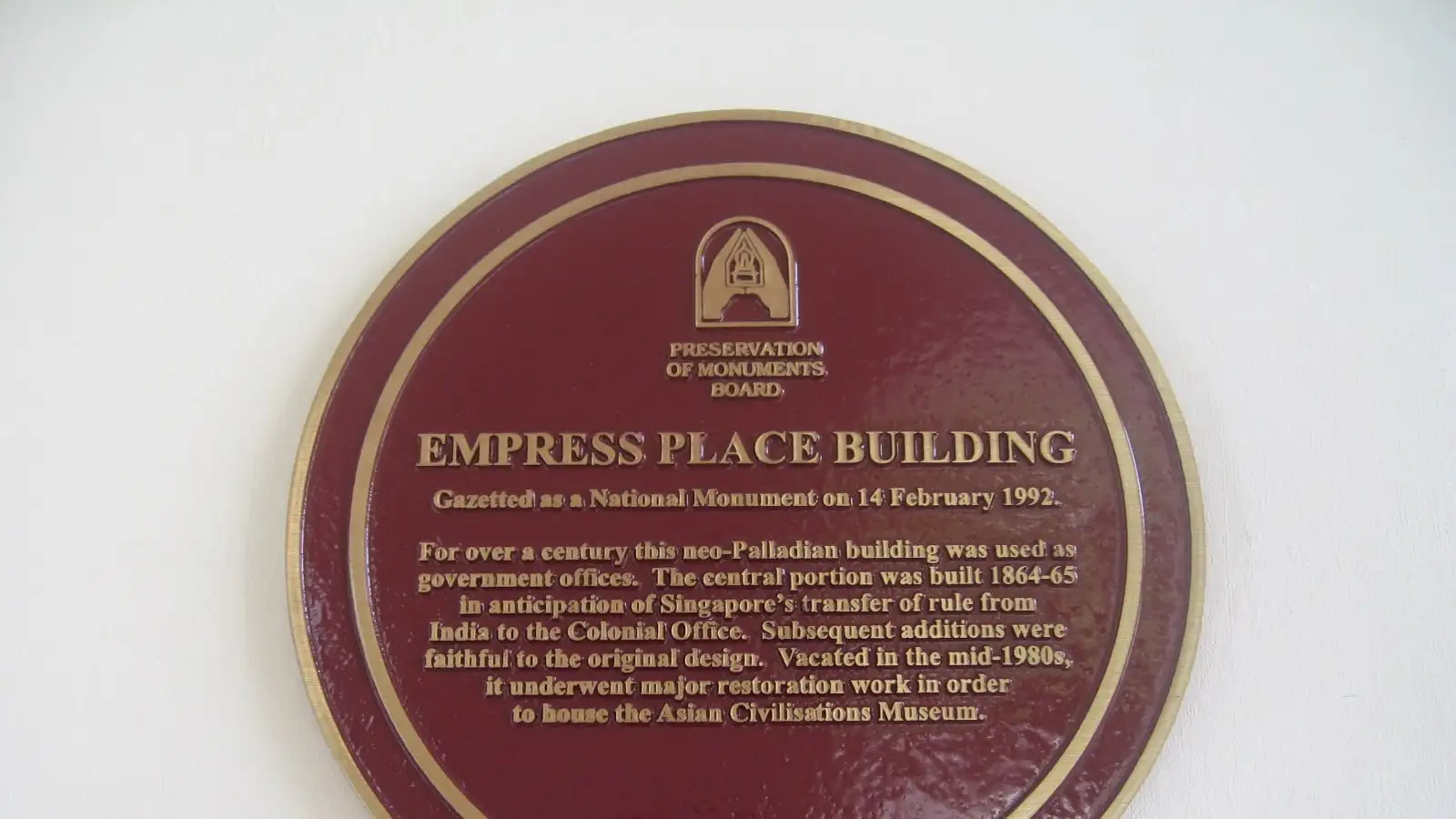
- The restored Empress Place Building on the river
Free for Singapore citizens and PRs on permanent galleries. Special exhibitions are ticketed on top.
Check pricesNational Gallery Singapore
$14.16 From · per person
The other half of a Civic District museum day.
- Singaporean and Southeast Asian art across two national monuments
- Over 9,000 works in the collection
- A five-minute walk from ACM
Also free for citizens and PRs; S$20 general admission otherwise. Allow three hours, not two.
Check pricesLowest price
Peranakan Museum
$9.44 From · per person
The lighter second museum, and the most local subject available.
- Permanent galleries on Peranakan culture
- The Armenian Street building that was the original ACM
- About ninety minutes
A ten-minute walk from ACM. The better pairing if National Gallery feels like too much in one day.
Check pricesThe Asian Civilisations Museum specialises in the material history of China, Southeast Asia, South Asia and West Asia — which is to say, in the ancestry of the people who live in Singapore. That framing is not decorative. It is why a museum in a small city-state holds a pan-Asian collection at all, and why the collection hangs together instead of reading as a grab-bag.
It opened on 22 April 1997 in the Old Tao Nan School building on Armenian Street, then moved its flagship to the restored Empress Place Building on the Singapore River on 2 March 2003. The Armenian Street building reopened in 2008 as the Peranakan Museum.
The Tang Shipwreck
If you visit one gallery in one Singapore museum, make it this one.
In 1998 a ninth-century Arab dhow was found off Belitung Island in Indonesia, carrying tens of thousands of Chinese ceramics along with gold and silver. It is the earliest and most complete physical evidence of direct maritime trade between Tang dynasty China and the Abbasid world — a sea route people had argued about for a century, sitting in a hold.
The gallery built around it shows the cargo more or less as a cargo: stacked bowls, thousands of them, in the volumes that make it obvious this was industrial-scale export rather than gift exchange. It reframes what you thought you knew about the period, and it takes twenty minutes.
What else is inside
The museum is arranged thematically rather than by country, which is unusual and works better than it sounds.
- Maritime Trade (Level 1) — the Tang Shipwreck and the wider story of Asian sea trade.
- Ancestors and Rituals (Level 2) — religious and ancestral objects across the region, from Hindu-Buddhist sculpture to Islamic material culture.
- Ceramics (Level 3) — the trade goods that moved along the same routes, over a thousand years.
Special exhibitions rotate through the ground-floor galleries. These are the part that is charged for everyone, and they are often loan shows from major international museums.
Who pays what
| Citizens and PRs | Other nationalities | |
|---|---|---|
| Permanent galleries | Free | General admission |
| Special exhibitions | Reduced rate | Full rate |
Recent special exhibitions have been priced at S$12 for Singaporeans and PRs against S$25 for foreign residents and tourists — roughly the ratio you should expect.
This mirrors the National Heritage Board policy across all its museums: permanent collections free to residents, exhibitions charged to everyone.
Timing is everything
Two hours is the right slot. ACM is a considerably shorter visit than National Gallery Singapore, which asks for three. That difference is what makes them pair well rather than compete.
Go in the afternoon if you are doing both. National Gallery in the morning while you have energy for three hours, lunch, then ACM from about 2pm. Two hours is a comfortable length for a second museum; three is not.
Weekday mornings are quietest. School groups arrive mid-morning and the riverside gets busy from lunchtime as the Boat Quay crowd builds.
Check the hours before a late visit. The museum runs until 7pm, but ticketing closes earlier and hours can shift during exhibition changeovers.
For photographs, the Empress Place frontage is best in the late afternoon when the light comes across the river, and the building is worth ten minutes from outside whether or not you go in.
The insider entry
Most visitors approach from City Hall MRT and the Padang, which means walking down past the National Gallery and around the front of the building with everyone else.
Come from Raffles Place (EW14/NS26) instead. It is a five-minute walk across the river at Cavenagh Bridge, you arrive at the riverside frontage rather than the road side, and you pass the Fullerton and the bumboat jetties on the way — which is a better ten minutes than the Padang crossing.
It also puts you in position to pick up the Singapore River Cruise at Boat Quay afterwards, without doubling back.
How to save
Check whether you are already free. Singapore citizens and permanent residents pay nothing for the permanent galleries. That covers the Tang Shipwreck, which is the reason to come.
Skip the special exhibition on a first visit unless it is specifically what drew you. It costs more than admission and covers less of what makes ACM worth visiting.
Do not buy a city pass for this. ACM is among the cheapest paid museums in Singapore, and multi-attraction passes are priced around theme parks. The maths never works in the museum's favour.
Pair it with the Peranakan Museum rather than the National Gallery if you want a lighter day. Both are around ninety minutes to two hours, both are NHB, and they are ten minutes apart.
The riverside is free. Empress Place, the Cavenagh Bridge, the Fullerton frontage and the Boat Quay shophouses cost nothing and are half of what makes this corner of the city worth an afternoon.
How to get there
Raffles Place (EW14 on the East West Line, NS26 on the North South Line) — five minutes on foot across Cavenagh Bridge.
City Hall (EW13/NS25) — a similar distance the other way, past the National Gallery and the Padang.
Clarke Quay (NE5) — about ten minutes along the river promenade, and the nicest approach on foot.
The address is 1 Empress Place, Singapore 179555.
What is nearby
ACM sits at the centre of the Civic District cluster. National Gallery Singapore is five minutes away, the National Museum ten minutes up Stamford Road, and the Peranakan Museum ten minutes towards Armenian Street.
Immediately outside are the Singapore River quays: Boat Quay shophouses, the Cavenagh and Anderson bridges, the Fullerton, and the river cruise jetties. The Merlion is five minutes downstream, and it is another twenty minutes on foot along the waterfront to Marina Bay Sands and the ArtScience Museum.
FAQ
Frequently asked questions
Is the Asian Civilisations Museum free?
The permanent galleries are free for Singapore citizens and permanent residents, as at all National Heritage Board museums. Other nationalities pay general admission. Special exhibitions are ticketed separately for everyone, with a resident rate typically around half the visitor rate.
How much do tourists pay?
General admission for the permanent galleries, plus a separate charge for whatever special exhibition is running. Recent special exhibitions have been priced at S$12 for Singaporeans and PRs and S$25 for foreign residents and tourists. Live reseller prices for admission are in the ticket table above.
What is the Tang Shipwreck?
A ninth-century Arab dhow that sank off Belitung Island in Indonesia carrying tens of thousands of Chinese ceramics, gold and silver. It is the earliest and most complete evidence of maritime trade between Tang China and the Abbasid world, and the gallery built around it is the single most remarkable thing in any Singapore museum.
How long do you need at ACM?
About two hours for the permanent galleries at a normal pace. Three if the current special exhibition is your reason for coming. It is a considerably shorter visit than National Gallery Singapore, which is why the two pair well in one day.
What are the permanent galleries?
The museum is organised thematically rather than by country. Maritime Trade is on Level 1 and includes the Tang Shipwreck; Ancestors and Rituals is on Level 2; Ceramics is on Level 3. The collections cover China, Southeast Asia, South Asia and West Asia.
What are the opening hours?
The museum is open daily until 7pm. Ticketing closes before the galleries do, and hours can shift during exhibition changeovers — worth a check on the operator's site if you are arriving late in the day.
Can I combine ACM with the National Gallery?
Easily, and it is the standard Civic District day. They are about five minutes apart on foot. Do National Gallery in the morning when it needs three hours and you have energy, then ACM after lunch when two hours is the right length.
Was ACM always at Empress Place?
No. It opened on 22 April 1997 in the Old Tao Nan School building on Armenian Street with a largely Chinese collection, and moved its flagship to the restored Empress Place Building on 2 March 2003 as the collection expanded across Asia. The Armenian Street building reopened in 2008 as the Peranakan Museum.
Related guides